Government - Confederates
President Davis writes Governor Thomas O. Moore of Louisiana of his concern over attack from both directions: "The wooden vessels are below, the iron gun boats are above; the forts should destroy the former if they attempt to ascend. The Louisiana may be indispensable to check the descent of the iron boats. The purpose is to defend the city and valley; the only question is as to the best mode of effecting the object.
Military - Union
Louisiana
In the passes and river below Fort Jackson and St. Philip, the large fleet of Flag Officer David Glasgow Farragut, and the mortar fleet of David Dixon Porter, and transports with troops of Benjamin F. Butler are gathering.
Missouri
Skirmishing occurs near Warsaw.
Tennessee
Skirmishing occurs near Pittsburg Landing, and near Woodson's Gap.
Mississippi
Skirmishing occurs near Corinth.
Virginia
A Union expedition from Summerville to Addison, in western Virginia, operates until the 21st.
In the Shenandoah, GEneral Banks troops continue to move forward, occupying New Market. Stonewall Jackson's troops retire slowly before them.
Bibliography
The Civil War Day By Day: An Almanac 1861-1865. E.B. Long with Barbara Long, De Capo, 1971

Sunday, April 17, 2011

Saturday, April 16, 2011
16 April, 1862: Wednesday
Government - Union
President Lincoln signs a bill ending slavery in the District of Columbia.
Military - Union
Alabama
Union troops occupy Tuscumbia.
Government - Confederates
President Davis approves an act of the Confederate Congress calling for conscription of every white mail between eighteen and thirty-five years of age for three year's service. The measure provided for administration of enrollment and draft by state officials, assignment to units from their own states, election of company, battalion and regimental officers, and for substitutions. There wew no specific exemptions; those provided by the act of April 21 exempted government officials, ferrymen, pilots, employees in iron mines and foundries, telegraph operators, ministers, printers, educators, hospital employees, and druggists among others. (There will be a number of later revisions to the exemptions.)
Military - Confederates
Virginia
There is an engagement at Lee's Mill, also known as Burnt Chimneys and Dam No. 1
There is minor fighting near Yorktown, on the Peninsula.
Georgia
There is skirmishing at Whitemarsh Island.
Missouri
There is skirmishing near Blackwater Creek.
__________
Bibliography
The Civil War Day By Day: An Almanac 1861-1865. E.B. Long with Barbara Long, De Capo, 1971
Friday, April 15, 2011
James H. Carleton
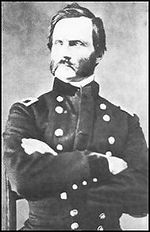
From Wikipedia:
James Henry Carleton (December 27, 1814 – January 7, 1873) was an officer in the Union army during the American Civil War. Carleton is most famous as an Indian fighter in the southwestern United States.
Biography
Carleton was born in Lubec, Maine. He was commissioned as a Lieutenant of the Maine militia in the Aroostook War and took part in the Mexican-American War. He served in the 1st U.S. Dragoons in the American West, participating as a Lieutenant in a friendly expedition in 1844 to the Pawnee and the Oto.
In May 1859, Brevet Major J.H Carleton leading K Company of the First Dragoons Fort Tejon CA escorted Major Henry Prince, paymaster U.S.A. with government funds to the Southern Utah Territory. Arriving at Mountain Meadows, the command rendezvoused with the Santa Clara Expedition of the Department of Utah from Camp Floyd under the command of Captain Ruben Campbell who had arrived in the area the previous week. With orders from General Clarke, commander of the Department of California, to bury the victims of the massacre that occurred in September 1857, the dragoons gathered the remains of 34 found scattered on the plain and buried them in one mass grave.
A crude monument was constructed of rocks with a cross of cedar and an engraved marker. Assistant Surgeon Charles Brewer of the Santa Clara Expedition was in charge of a burial detail that had interred the remains of 39 in three mass graves a few days before the arrival of K Company.
After an investigation of the incident, Major Carleton felt his findings were of such merit to warrant the issuance of a Special Report to Major W. W. Mackall, Assistant Adjutant-General, U.S.A., San Francisco, California. Major Carleton concluded that Mormons, some dressed as Indians, had murdered and plundered the possessions of 120 men, women, and children of a California bound emigrant train with the assistance of Paiute Tribesmen. In 1860, Major Carleton, attacked suspected Paiute raiders along the Mojave Road with a reinforced 1st Dragoons, Company K.
In 1861 Carleton raised and was appointed colonel of the 1st California Volunteer Infantry Regiment. In October 1861, Colonel Carleton replaced Brigadier General George Wright as commander of the District of Southern California. In 1862 he led the so-called California Column across California, Arizona, New Mexico, and into Texas. Along the way the Californians fought the Battle of Picacho Pass and, afterward, the Battle of Apache Pass. Carleton was promoted to Brigadier General of volunteers on April 28, during the march from California to Arizona. He also established Fort Bowie near Apache Pass.
Carleton finally linked up with Union forces under General Edward R. S. Canby in New Mexico. After the Confederate threat to New Mexico seemed to have been eliminated, Canby and many of the Union forces were sent to the east; so, in late August, Carleton was placed in command the Department of New Mexico. Because of uncertainty as to whether the Confederates would try to re-invade New Mexico, Carleton took measures such as maintaining spies along the New Mexico-Texas border and retaining the services of volunteer units from Colorado which had played a prominent role in expelling the Confederates from New Mexico in the winter and spring of 1862.
During his tenure as department commander, Carleton was mainly concerned with Indian threats. His primary field commander was Colonel Christopher "Kit" Carson. Carleton campaigned relentlessly against the Indians, and although he was strong on discipline, he was popular with his men.
Against the Navajo he elected scorched earth tactics. Carleton's campaigning brought the depradations of the Navajo to an end at Canyon de Chelly, and was followed by the "Long Walk". Carleton next sent Carson on an expedition to rid the southwest of Indian raids which resulted in the Battle of Adobe Walls. Carleton was appointed brevet major general in the regular army in 1865, the same year that the Civil War ended. He retained command of his volunteer troops until 1866 when U.S. Regulars took over in the West. Carleton served as a lieutenant colonel of the 4th U.S. Cavalry after the war.
Carleton wrote several books on the military: The Battle of Buena Vista (1848), Diary of an Excursion to the Ruins of Abo, Quarra, and the Grand Quivira in New Mexico in 1853 (1855) and The Prairie Log Books (posthumous, 1944). It was partly on the strength of The Battle of Buena Vista that Carleton received an appointment from Secretary of War Jefferson Davis in 1856 to make a study of European cavalry tactics.
Carleton did not make the trip abroad himself, but based his report on the observations of Gen. George B. McClellan who had recently returned from Europe. One of Carleton's children, Henry Guy Carleton (1852–1910) was a journalist, playwright, and inventor. General Carleton died in San Antonio, Texas, and is buried in Mount Auburn Cemetery, Cambridge, Massachusetts; his son, Henry was later buried beside him.
General Ormsby Mitchel

From Wkipedia
Ormbsy MacKnight (or McKnight) Mitchel (August 28, 1810, or possibly 1809, – October 30, 1862) was an American astronomer and major general in the American Civil War.
A multi-talented man, he was also an attorney, surveyor, and publisher. He is notable for publishing the first magazine in the United States devoted to astronomy. Known in the Union Army as "Old Stars", he is best known for ordering the raid that became famous as the Great Locomotive Chase during the Civil War.
The U.S. communities of Mitchell, Indiana, Mitchelville, South Carolina, and Fort Mitchell, Kentucky were named for him, as was an impact crater on the planet of Mars.
Early life and careerMitchel was born in Union County, Kentucky, but grew up in Lebanon, Ohio. He was a clerk, but left that job when he received an appointment to the United States Military Academy in 1825, where he was a classmate to Robert E. Lee and Joseph E. Johnston. He graduated in 1829, placing 15th out of 46 graduates. Mitchel stayed at West Point as assistant professor of mathematics for three years. He helped establish observatories for the United States Navy and at Harvard University.
He passed the bar and became an attorney, but in 1836 became assistant professor of mathematics and natural philosophy at Cincinnati College. He was instrumental in establishing the college's law school, and on his first vacation, surveyed and recommended the route of the planned Little Miami Railroad between Cincinnati and Springfield, Ohio.
In 1845, he was appointed director of an observatory established at Cincinnati College through his initiative. At the time, it featured the second-largest refracting telescope in the world. He published the first monthly magazine in the United States devoted specifically to astronomy. In 1859, Mitchel became superintendent of the Dudley Observatory at Albany, New York, where he continued his pioneering work on the development of telegraphic determination of longitude.
Civil War
During the Civil War, he entered the Union Army with a commission as brigadier general of volunteers. He first organized the northern Kentucky defenses around Cincinnati. He commanded the Department of the Ohio from September to November 1861. During this time, he conspired with espionage agent James J. Andrews on plans to steal a train in Georgia and disrupt a railroad vital to the Confederate States Army coincident with Mitchel's planned attack on Chattanooga, Tennessee. The raid failed, as did Mitchel's military operation. Andrews and a number of his men were captured. Andrews himself was among eight men who were tried in Chattanooga. They were hanged in Atlanta by Confederate forces, but were later buried in the National Cemetery at Chattanooga in 1887.
Although a military failure, the story of Andrew's Raid became known to American history as the Great Locomotive Chase, and has been retold in publications and film. The pursuit of Andrews' Raiders formed the basis of the Buster Keaton silent film The General and a dramatic 1956 Walt Disney film, The Great Locomotive Chase.
General Mitchel led a division in the Army of the Ohio from December 1861 to July 1862, and was placed in charge of the defense of Nashville, Tennessee, with headquarters in the vicinity of Shelbyville, Tennessee. He became famous when he seized the city of Huntsville, Alabama in April 1862 without a shot being fired, after he led his troops there from Shelbyville in a surprise maneuver. He was promoted to major general for his efforts.
In September 1862, he assumed command of the X Corps and the Department of the South at Hilton Head, South Carolina, but died in Beaufort of yellow fever shortly after assuming his post. He is buried in Green-Wood Cemetery in Brooklyn, New York.
Legacy
-A persistently bright region near the Mars south pole that was first observed by Mitchel in 1846 is named in his honor - 'The Mountains of Mitchel'. It is located near 70°S, 40°E.
-An impact crater on Mars was named in his honor.
-The new town (and later city) of Mitchell, Indiana was name for him after he surveyed it for the owners while working on the Ohio and Mississippi Railroad in the 1850s. (The second "L" was added later).
-The first post-Civil War freedmen's town created in the United States (on Hilton Head Island, South Carolina), Mitchelville, was name for him.
-Fort Mitchell, Kentucky — an aberrant spelling — was also named for him.
-A descendant and namesake, Lt. Ormsby M. Mitchel, Jr., was awarded the Navy Cross in 1943 for extraordinary heroism in trying to save the crew of his doomed USS Plymouth after it had been struck by a torpedo fired by a German U-boat off the Virginia coast.
15 April, 1862: Tuesday
Union - Military
New MexicoThere is a skirmish at Peralta.
Missouri
There is a skirmish at Lost Creek.
Arizona
There is a small battle at Picacho Pass, which the Union wins, thus threatening the Confederates in Tucson.
_____
Bibliography
The Civil War Day By Day: An Almanac 1861-1865. E.B. Long with Barbara Long, De Capo, 1971
Thursday, April 14, 2011
14 April, 1862: Monday
Union - Military - Naval
Tennessee
Union mortar boats bombard Fort Pillow, Tennessee on the Mississippi River.
Virginia
The US naval flotilla on Chesapeake Bay carries out reconnaissance on the Rappahannock.
Missouri
There are skirmishes at Montevallo, Diamond Grove and near the SAnta Fe Road.
South Carolina
Union troops make a reconnaissance on Seabrook Island.
_____
Bibliography
The Civil War Day By Day: An Almanac 1861-1865. E.B. Long with Barbara Long, De Capo, 1971
Wednesday, April 13, 2011
13 April, 1862: Sunday
Union - Military
New Mexico
Beginning from now until nearly the end of April, Union troops pursued the retreating Confederates into New Meico Territory, until the Confederates reached the El Paso area.
California
On this day, a Union expedition left southern California, under James H. CArleton, moving through Arizona to New Mexico and northwestern Texas. (The expedition will end on Sept 20.)
Mississippi
On the Tennessee River, Union troops carry out a reconnaissance on the Corinth, Mississippi and Purdy, Tennessee roads.
North Carolina
There is a skirmish at Gillett's Farm, on Pebbly Run.
Alabama
Union forces under GEneral Ormsby Mitchel occupies Decatur, Alabama on the Tennessee River.
_____
Bibliography
The Civil War Day By Day: An Almanac 1861-1865. E.B. Long with Barbara Long, De Capo, 1971
Subscribe to:
Posts (Atom)